
UGC Recognized 2-Year Postgraduate Degree Program
MBA Aviation Management equips students with in-demand skills in Airport Operations, Airline Management, Aviation Safety, Aviation Marketing, Cargo Management, and Aviation Business Strategy, preparing them for leadership careers in the rapidly growing global aviation industry.
Gain expertise in the business, operations, and management functions that drive airports, airlines, and aviation organisations worldwide.
Develop knowledge in Airport Management, Airline Operations, Aviation Safety, Cargo Management, Aviation Marketing, and Emerging Aviation Technologies.
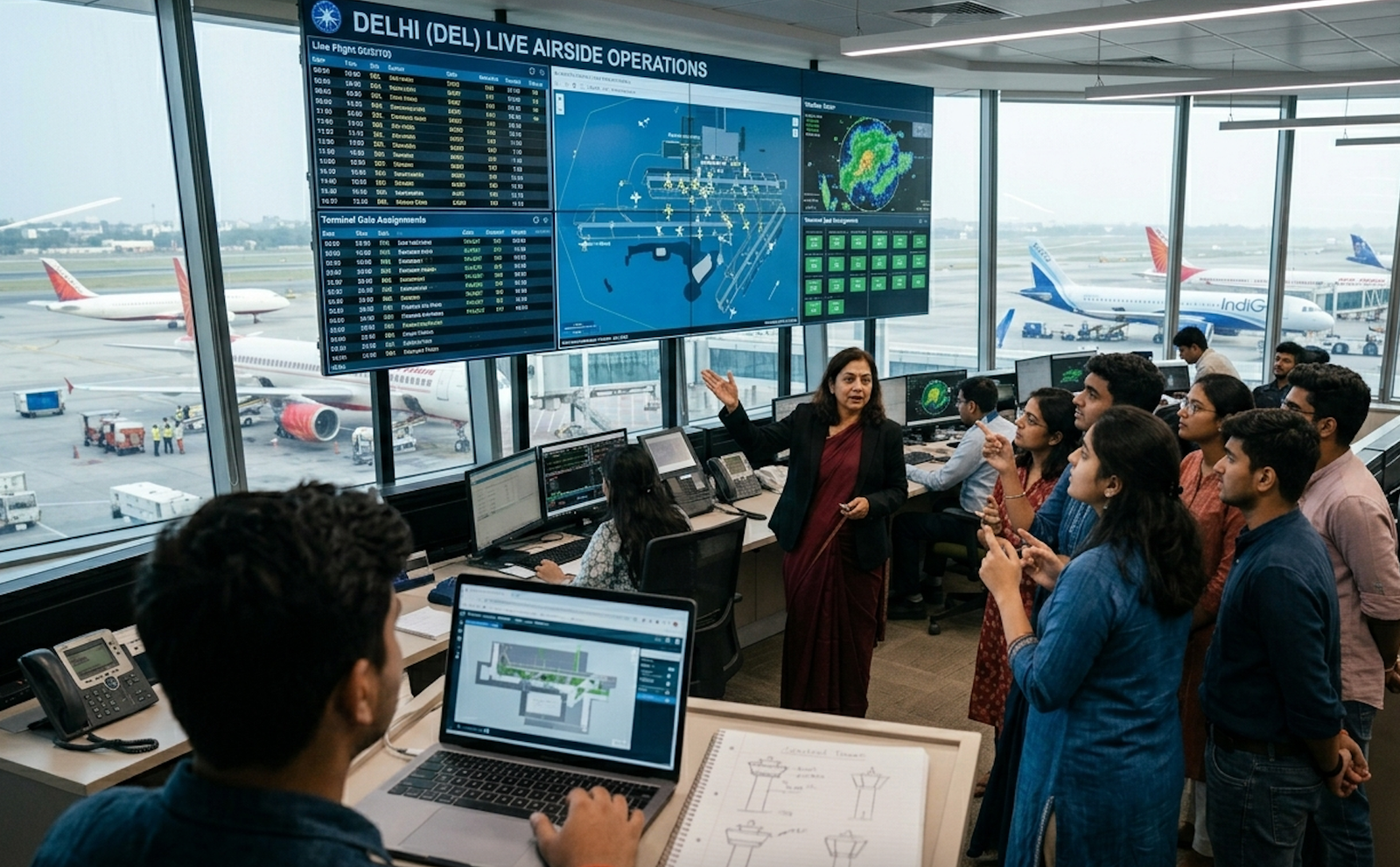
Build industry-ready skills through internships, airport visits, live projects, case studies, and expert-led training sessions.
Benefit from strong demand for aviation professionals as airports, airlines, and aviation infrastructure continue expanding across India and globally.
The MBA Aviation Management program develops strong foundations in business management while building specialised expertise in airport operations, airline management, aviation safety, cargo logistics, and aviation business strategy.
Students learn how airports, airlines, aviation service providers, and global aviation networks operate while gaining practical insights into aviation regulations, customer experience, operational efficiency, and industry management. The program combines management principles with aviation-focused learning through projects, case studies, and industry exposure.
The curriculum is designed to ensure graduates are equipped with both managerial competencies and aviation industry knowledge, making them valuable professionals across airlines, airports, aviation service providers, logistics companies, and travel organisations.
Potential Starting Salaries of ₹5 LPA – ₹10 LPA, with career opportunities across Airport Operations, Airline Management, Aviation Safety, Cargo Operations, Ground Handling, Aviation Marketing, and Aviation Business Development.
2 Industry Internships during the program, providing practical exposure, airport interaction, real-world project experience, and industry-ready skills.
Industry Certification in Aviation Management, providing industry-relevant knowledge in Airport Operations, Airline Management, Aviation Safety, and Aviation Business Practices.
Hands-On Learning in Aviation Operations & Management, enabling students to understand airport systems, airline operations, passenger services, and aviation regulations.
Industry-Integrated Curriculum, covering Airport Management, Airline Operations, Aviation Safety, Aviation Marketing, Cargo Management, and Aviation Business Strategy.
Exposure to Industry Tools & Technologies, including Aviation Management Systems, Airport Operations Platforms, Cargo Management Systems, Reservation Systems, and Aviation Analytics Tools.
Aviation Operations & Customer Experience Training, helping students understand passenger handling, service excellence, airport coordination, and operational efficiency.
Live Projects, Case Studies & Industry Masterclasses, delivered by aviation professionals, airport experts, and industry leaders.
Practical Exposure to Airport & Airline Operations, helping students understand aviation regulations, safety procedures, operational planning, and business management.
Global Industry Opportunity, with aviation among the fastest-growing industries worldwide as air travel, airport infrastructure, and airline networks continue expanding.
Placement Assurance & Career Development Support, including resume building, interview preparation, soft-skills training, professional mentoring, and career guidance.
Experience industry-focused education at the UniSkills Bengaluru Campus, with the program awarded through Rai Technology University, Bengaluru. Located in the heart of India's innovation capital, the campus combines modern infrastructure with practical learning, expert mentorship, internships, and valuable industry exposure. Its strategic location enables students to connect with top employers and build careers in one of the country's fastest-growing business ecosystems.

Graduates may pursue careers such as:
Students benefit from:
These experiences help students understand how Leading Airports work also how AI solve challenges and drives innovation.
Real stories from learners achieving their corporate goals.

"UniSkills provided an excellent learning experience with practical exposure and industry-focused training. The faculty members were highly supportive throughout the journey."

"The Digital Marketing & AI program helped me gain hands-on experience in SEO, Social Media Marketing, and AI-powered marketing tools."

"The Data Science curriculum was well-structured and industry-oriented. It significantly improved my analytical and technical skills."

"The Healthcare Management program provided me with practical knowledge and leadership skills required in the healthcare industry."

"The Cyber Security course covered ethical hacking, network security, and digital forensics in great detail with real-world case studies."

"The faculty and placement support team were exceptional. The learning environment was professional and student-friendly."
A regular MBA provides broad management knowledge, whereas an MBA Aviation Management combines business management with specialized aviation expertise. This gives graduates a competitive advantage when applying for leadership roles in airports, airlines, cargo operations, and aviation services.
Yes. India is projected to become one of the world's largest aviation markets. Airport expansion, airline growth, cargo operations, and smart aviation technologies are creating thousands of new management opportunities across the aviation ecosystem.
Yes. Graduates from any discipline—including BBA, BCom, BA, BSc, Engineering, Hospitality, Tourism, and other streams—can pursue MBA Aviation Management.
Students develop skills in leadership, strategic planning, operations management, customer experience management, project management, aviation business management, team leadership, and decision-making.
Airport Management focuses primarily on airport operations, while Aviation Management covers a broader ecosystem including airports, airlines, cargo operations, aviation services, aviation finance, aviation marketing, and aviation strategy.
Yes. The program is designed to prepare students for supervisory and management-track roles by combining business education, industry exposure, practical learning, and aviation specialization.
AI is transforming aviation through predictive maintenance, airport automation, passenger analytics, flight scheduling, baggage management, security systems, and customer experience enhancement. Understanding AI gives graduates a significant advantage in the future aviation workforce.
Yes. Aviation is a global industry with standardized operational practices. The skills learned in this program are relevant for airports, airlines, and aviation organizations worldwide.
UniSkills combines an industry-oriented curriculum, AI-integrated learning, internships, industry certifications, expert faculty, placement support, and practical exposure to airport and airline operations. Students graduate with both management expertise and industry-ready aviation skills, preparing them for leadership careers in one of the world's fastest-growing industries.
| Component | Amount |
|---|---|
| Application Fee | ₹1,100 |
| Registration Fee | ₹30,000 |
| Tuition Fee (Per Year) | ₹200,000 |
| Semester Fee (Every Semester) | ₹2,500 |
Annual fees for subsequent academic years are payable before 15th April.
Examination, certification, convocation, transport, and other applicable charges may apply as per university guidelines.
Complete the application form and pay the Application Fee if ₹1,110.
Submit your academic documents and Supporting credentials for admission processing.
Appear for the UniSkills Entrance Test designed to assess aptitude, communication skills, and academic readiness.
Faculty interaction to evaluat your motivation program.
Confirm your admission by paying the Admission Fee of ₹30,000 and completing the balance program fee payment as per the selected course
Fulfill the remaining enrollment formalities. Attend orientation, meet your faculty, and start building the skills required for tomorrow's careers.





Explore our training milestones, campus events, and program frameworks.